
Tech stack
Project breakdown
Messenger - Real-time Chat Application
Realtime messaging · Modular Laravel backend · Self-managed event pipeline
Role: Solo developer. I designed the architecture, built the product, and deployed the full stack myself.
Laravel · Next.js · TypeScript · Redis · Socket.io · Docker · MySQL · Redux Toolkit · React Query
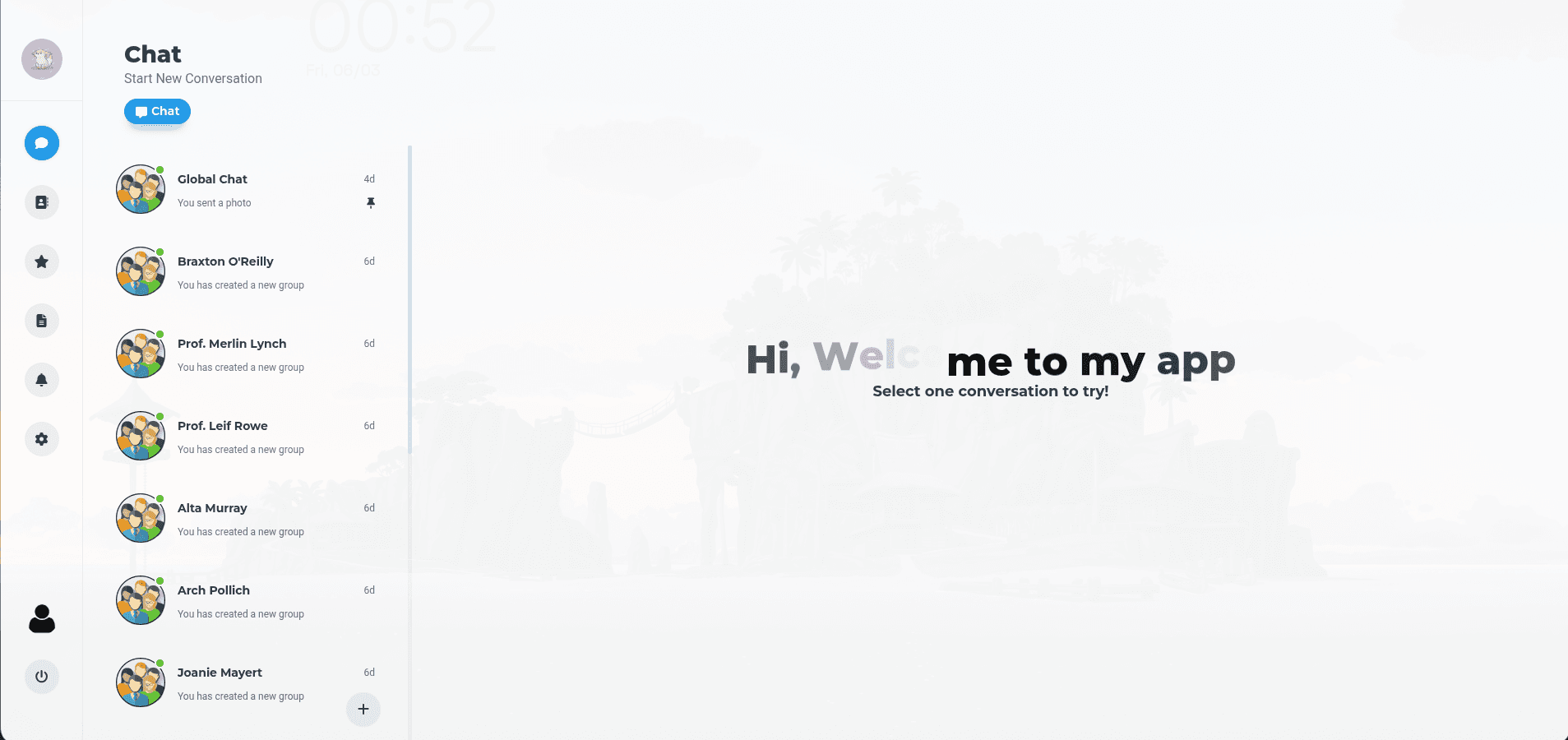
Messenger is a chat product for direct messages and groups. It supports media sharing, reactions, seen state, and live sidebar updates without polling. The main technical goal was making the full realtime path visible and controllable, from database write to Redis pub/sub to Socket.io delivery on the client.
System Architecture
The product uses a self-hosted Echo Server rather than a managed push service. That trade-off increases operational responsibility, but it made the event pipeline transparent and tunable.
Real-time Messaging
Problem: Chat UX falls apart if a message, status update, or sidebar preview waits on polling. But trusting every inbound real-time event blindly can also create duplicates or stale state after reconnects.
Solution: Build an event-driven delivery path backed by Redis pub/sub and a client strategy that combines socket events with controlled refetches after reconnect.
Implementation highlights:
- The API stores the message then broadcasts
MessagesSentEvent - Redis carries the event to Laravel Echo Server
- Socket.io pushes the event to subscribed clients
- The frontend updates Redux state immediately for message lists and sidebar previews
- Reconnect handling uses debounce and refetch instead of assuming every event is complete
Result: Conversations feel instant while state remains recoverable after transient connection problems.
Modular Monolith
Problem: Chat, auth, media, and user management quickly become hard to maintain when all logic lives in a flat application structure.
Solution: Organize Laravel as a modular monolith with domain boundaries that mirror the real product.
Implementation highlights:
- Four main modules: Auth, Conversation, Media, and User
- Each module owns controllers, services, repositories, transformers, migrations, and routes
- Service classes call repositories instead of working directly against models
- The frontend mirrors the same separation with
features/authandfeatures/chat
Result: Work on messaging no longer spills into unrelated auth or media code, and the domain boundaries remain understandable as the codebase grows.
Dockerized Deployment
The runtime consists of seven cooperating services: PHP, Nginx, MySQL, Redis, Echo Server, queue workers, and Mailcatcher in development.
Key deployment choices:
- Docker Compose for both development and production variants
- Health checks so services only start once dependencies are ready
- Internal database/network isolation so MySQL and Redis are not publicly exposed
- Supervisor to keep queue workers alive after crashes
That deployment setup reduced machine setup time from manual hours to one command.
CI/CD & Deploy
docker composedrives local and production environments- Production deploys run through the production compose file and migration hooks
- Health checks and supervisor-based worker restarts are built into the operational flow
Key screens
Messaging Platform
Core messaging flow for direct chat, group chat, media sharing, and presence updates.